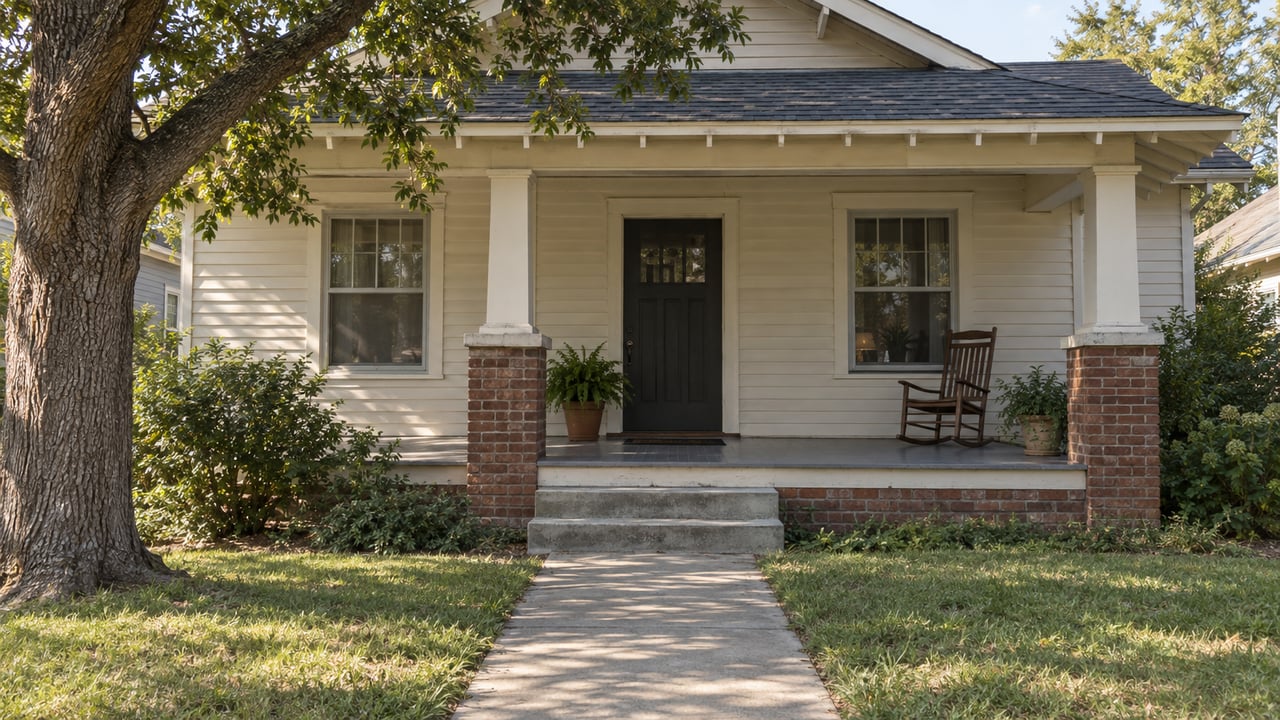
A house on Bell Street in Shawnee carries a label most buyers and sellers have never had to think through: it sits inside a National Register historic district. The phrase does a lot of work in a listing description. It also does almost none of the work most people assume it does.
The Bell Street Historic District was added to the National Register of Historic Places through a nomination filed in 2000, prepared by Charlotte Patterson of Patterson/Johnson Architects. That listing put a cluster of Pottawatomie County homes into a federal database of places worth remembering. It did not create a design review board. It did not require anyone on Bell Street to ask permission before replacing a roof, repainting a porch, or swapping out original windows for something more energy efficient. For an owner living in the house and not chasing a federal tax benefit, the National Register entry is closer to a plaque than a permit process.
What the 2000 Listing Actually Did
Getting a property or a district onto the National Register runs through Oklahoma's State Historic Preservation Office, a division of the Oklahoma Historical Society. The office identifies, evaluates, and nominates properties, and it reviews federal undertakings that might affect them. That last part matters: the review authority is tied to actions involving federal money or federal permits, not to whatever a private homeowner decides to do with their own roof shingles.
There's a detail in Oklahoma's National Register process that rarely makes it into a listing description but says a lot about what the designation actually is. Property owners have the right to object to being listed. If a simple majority of private owners in a proposed district file a notarized objection with the State Historic Preservation Office, the district doesn't get listed. Bell Street's homes are on the National Register because, in 2000, enough owners either supported the nomination or didn't object strongly enough to block it. That's a community choosing to be recognized, not a government body imposing a rule from outside.
The Board That Doesn't Exist on Bell Street
Compare that to what a real design review requirement looks like elsewhere in Oklahoma. Oklahoma City's Capitol-Medical Center Improvement and Zoning District, created by state law in 1974, has its own zoning commission and a subordinate Historical Preservation and Landmark Board of Review. Inside that district, exterior work on a historic property requires a Certificate of Appropriateness, reviewed against a formal set of state standards and guidelines before a homeowner can touch a facade. That board exists because Oklahoma City's legislature-created district was built to include one.
Shawnee's own zoning code lays out its districts by name: low-density residential, medium-density residential, the Downtown district, the Twin Lakes district, light and heavy industrial, and a category for special districts and overlays. Nothing in that structure functions as a Bell Street equivalent to Oklahoma City's landmark board. The National Register listing gave Bell Street a place in the federal registry. It didn't give Shawnee a local ordinance that mirrors the Capitol-Medical Center model. Those are two different legal mechanisms, and only one of them touches what a private homeowner can do to their own house without asking anyone first.
The One Situation Where Design Standards Actually Apply
There's a real scenario where a Secretary of the Interior's design standard does come into play for a National Register property, and it's worth knowing precisely because it's narrower than most people expect. The federal rehabilitation investment tax credit gives owners of certified historic structures a 20 percent credit against the cost of a qualified rehabilitation, but that credit is built for income-producing property: rentals, commercial buildings, mixed-use conversions. To claim it, the rehab work has to meet the Secretary of the Interior's Standards for Rehabilitation, and the State Historic Preservation Office reviews the work against those standards.
That's the design review most people picture when they hear "historic district." It exists. It's real. It just isn't automatic, and it isn't triggered by owning a house on Bell Street and living in it. It's triggered by choosing to pursue a specific federal incentive tied to income-producing use. Shawnee's own Aldridge Hotel, currently being renovated into apartments for low-income and senior residents, is the kind of project that would run through this exact process, because it's income-producing and because that kind of adaptive reuse is often financed in part through historic tax credits. A single-family home changing hands on Bell Street is not that project.
What This Means at the Closing Table
For a seller on Bell Street, this changes the pre-listing checklist in a useful way. There's no Certificate of Appropriateness application to file before repainting the trim or replacing a section of siding ahead of a listing photo shoot. There's no board meeting to wait on before a buyer's home inspector flags a repair. The renovation timeline that would exist inside a district with a real local ordinance, like Oklahoma City's Capitol-Medical Center area, simply doesn't apply here.
For a buyer, the more useful question isn't "what does the historic district restrict," it's "what condition is the house actually in." Shawnee's downtown core and surrounding residential districts were intensively surveyed by the state preservation office, and that survey turned up roughly 3,500 structures across the city that are more than 50 years old. Houses that age carry the same practical realities whether or not they sit inside a National Register boundary: original wiring that may need updating, plumbing that's been patched more than once, rooflines that have seen several decades of Oklahoma weather. None of that is a historic district rule. It's just what comes with buying something built before your grandparents were.
The one case where a buyer or seller genuinely needs to slow down and check is financing. If a renovation loan, demolition permit, or any part of a transaction involves federal funding or a federal license, that's when Section 106 style review can enter the picture, because the SHPO's authority runs to federally assisted or federally licensed undertakings. A conventional purchase with private financing and no federal rehab credit in play doesn't cross that line.
Before You List or Make an Offer on Bell Street
A few questions worth asking, in order:
- Is the house being sold as-is for owner occupancy, or is a buyer planning to convert it to a rental or commercial use? The answer determines whether the federal rehab tax credit, and its design standards, is even relevant.
- Does any part of the financing involve federal loan guarantees, federal grants, or federal permits for site work? If not, there's no Section 106 review to plan around.
- What condition are the roof, wiring, and plumbing in, independent of the historic designation? A pre-listing inspection answers this faster than any research into district status.
- Is the buyer's lender aware the property is inside a National Register district, and does that change underwriting? This is worth a direct conversation with a lender early, since it varies by institution rather than by any state or federal rule.
A Few Questions That Come Up Often
Does National Register listing lower my property taxes? The federal benefit tied to National Register status is the rehabilitation tax credit, and it applies to income-producing property undergoing certified rehabilitation, not a blanket reduction on an owner-occupied home's tax bill.
Can I tear down a contributing structure on Bell Street? Nothing in the National Register listing itself blocks a private owner from demolishing their own property, though local building and demolition permitting still applies the way it would to any structure in Shawnee, and any federal funding tied to the demolition would bring SHPO review into play.
Does the historic designation affect homeowners insurance? Age and construction materials of the house drive underwriting more than the historic district label does, which is one more reason a pre-listing inspection matters more than a title search on the district's status.
Shawnee earned a Preserve America Community designation in November 2004, and the city has backed that recognition with real infrastructure: a tax increment finance district that redirects new tax revenue into the commercial core, and a Main Street Program that works alongside Downtown Shawnee, Inc. and the Historical Society of Pottawatomie County on heritage tourism and reuse projects like the Aldridge Hotel. That's a city investing in its history deliberately, through programs it created and funds. Bell Street's National Register listing is part of that same story, but it's a federal recognition, not a local rulebook, and knowing the difference is what keeps a straightforward sale from turning into a research project.
If you're weighing a purchase or a listing on Bell Street, or anywhere else in Shawnee's older neighborhoods, Daniel Sweeney can walk through what the property's history actually means for your timeline, your financing, and your closing, so you're planning around the real rules instead of the assumed ones. Schedule your free consultation to get the specifics for your address.